
Awning Installation in Fairfield, CT | Professional Setup & Repair
- Morgan Outdoor
- Feb 10
- 4 min read

Awning installation in Fairfield represents a significant home improvement investment that merges aesthetic enhancement with practical utility, offering residents a proven method for expanding living space, improving energy efficiency, and elevating property value. Unlike simple off-the-shelf purchases, awnings require precise measurement, structural assessment, and expert fitting to ensure they perform reliably through the coastal New England climate.
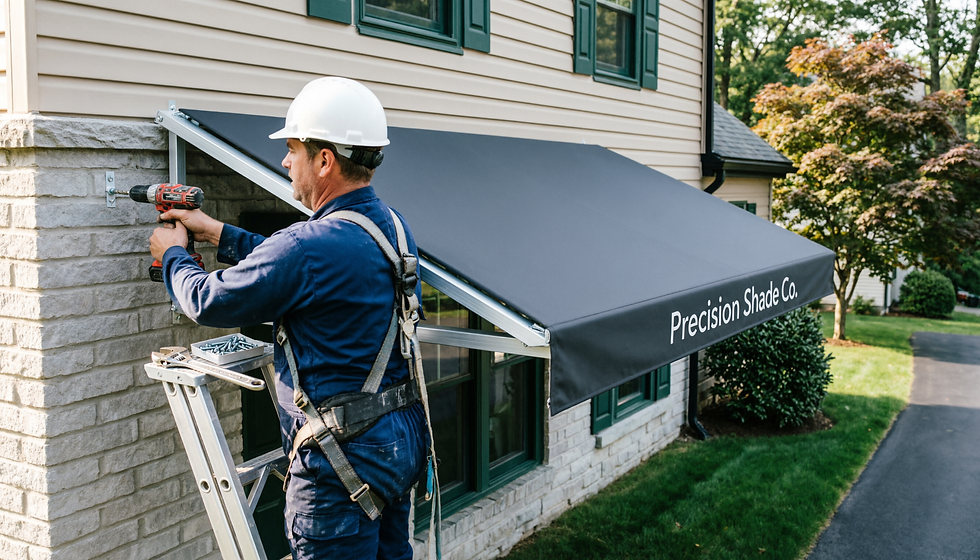
Professional installation is not merely a recommendation but a critical component of the awning's lifespan and functionality, safeguarding against common issues such as improper water runoff, wind instability, and premature wear. For homeowners across Fairfield County, from the historic districts to newer developments, understanding the installation process—from initial consultation and permit acquisition to the final mounting and adjustment—is key to achieving a seamless integration that protects both the awning and the home's exterior. This guide details every phase of professional awning installation, providing clarity on what to expect and how to ensure a durable, beautiful result that stands up to local weather conditions.
The Critical Importance of Professional Assessment and Planning
The installation process begins long before any tools touch the home's exterior. A professional installer initiates the project with a thorough site assessment, evaluating several key factors unique to each Fairfield property. This includes examining the intended mounting surface—whether it is wood siding, brick, stucco, or vinyl—to determine the appropriate anchoring methods and hardware required for a secure hold.
The installer assesses structural integrity, ensuring the wall or soffit can support the awning's weight and potential wind load, a crucial consideration given occasional coastal storms. They also analyze sun patterns, window and door alignments, and desired coverage to recommend optimal awning size, projection, and pitch for effective shade and water drainage.
This planning stage often involves reviewing local Fairfield or town-specific building codes and homeowners' association (HOA) guidelines, which may dictate permissible styles, colors, and projection distances. A reputable professional handles the permit application process if required, ensuring all work is fully compliant, thereby preventing future legal or insurance complications. This foundational step ensures the awning is not only beautiful but also code-compliant and engineered for safety.
Detailed Breakdown of the Installation Process and Techniques
Once planning is complete, the physical installation follows a meticulous, multi-step procedure conducted by experienced technicians. For a standard fixed awning, the process typically starts with precise marking and preparation of the mounting points on the home's exterior. Technicians then carefully drill pilot holes and install heavy-duty lag bolts or masonry anchors directly into the home's framing or solid substrate, avoiding hollow spots that could compromise stability.
The awning frame is lifted into place and securely fastened to these anchors. A critical aspect often overlooked in DIY attempts is ensuring the perfect pitch or angle; professionals use levels and lasers to set a slight downward slope away from the house, typically a quarter-inch per foot of projection, which is essential for proper rainwater runoff and preventing pooling that can lead to fabric sagging or frame stress.
For retractable awnings, the process is more complex, involving the secure mounting of the roller tube and headbox, precise alignment of the support arms, and the careful connection and testing of motorized components or manual mechanisms. Electrical wiring for motorized units is run discreetly and safely, often back to an existing outdoor-rated outlet or a newly installed one by a licensed electrician. The final step involves attaching the fabric cover with precision, ensuring it is taut and correctly engaged with the roller mechanism for smooth operation.
Material and Hardware Considerations for Longevity in Fairfield's Climate
The success of an installation is intrinsically linked to the quality of materials and hardware used, which must be selected specifically for durability in Fairfield's environment. Professional installers utilize corrosion-resistant hardware, such as stainless steel or hot-dipped galvanized lag bolts and anchors, to prevent rust stains and weakening over time.
The mounting brackets and awning framework are typically powder-coated aluminum or steel, chosen for its resistance to salt air and humidity. The choice of awning fabric also impacts installation; high-end solution-dyed acrylics or vinyl-laminated polyesters are tensioned appropriately—neither too loose nor too tight—to account for natural expansion and contraction with temperature changes. Installers ensure that all seals and end caps are properly fitted to prevent water ingress into the roller mechanism or frame.
For installations over doors or in high-traffic areas, additional support posts or vertical columns may be recommended to enhance stability. This focus on marine-grade or weather-rated materials and robust fastening techniques is what differentiates a professional Fairfield installation from an amateur one, directly impacting the awning's ability to withstand sun, rain, wind, and winter weather for a decade or more.
FAQs
How long does a typical awning installation take?
The timeline varies based on complexity. A simple fixed awning over a window can often be installed in a few hours. A larger retractable patio awning with motorization may require a full day, especially if new electrical wiring is needed.
Can awnings be installed on any type of siding?
Yes, professional installers are equipped to work with all common siding materials. The technique and hardware change based on the substrate.
What is the best time of year to install an awning in Fairfield?
Spring and early fall are ideal, offering mild weather for the installers and allowing you to enjoy the awning immediately for the upcoming season.
Do I need to be home during the installation?
Yes, it is generally required that the homeowner or an adult representative be present. This allows for final verification of positioning, a walkthrough of operation instructions, and to address any last-minute questions.
How do I verify a contractor is qualified for awning installation in Fairfield?
Select a licensed, insured, and bonded contractor with specific experience in awning installation.


Comments